
Facing a mountain of deferred maintenance backlog and don’t know where to start? We’ve got you covered.
Across the U.S., building operators are facing a challenging combination of aging infrastructure, rising utility costs, shrinking capital budgets, and corporate environmental goals. Drowning in deferred maintenance (DM) backlogs, too often they are trapped in a reactive cycle, focusing on fixing equipment only when it completely breaks or when occupants complain loudly enough.
If you’re managing a campus or a large portfolio of buildings, this likely sounds all too familiar. Don’t know where to start? Let’s talk about it.
 The Magnitude of the Problem
The scale of deferred maintenance in the U.S. is massive. Estimates suggest there is about $1 trillion in infrastructure-related deferred maintenance across the U.S., and it’s only growing. Federal agencies saw their DM and repair costs skyrocket from $51 billion in FY2017 to $76 billion in FY2021. Much of that is just to “get back to status quo”, and addressing priorities like energy efficiency or long-term campus planning are an afterthought. Even still, much of that need remains well under-funded. The most recent University of California Consolidated Capital Report documented over $1 billion in deferred maintenance and capital renewal projects across their projected $27 billion in capital spend through 2031. The kicker? An additional $9 billion in deferred maintenance that has been identified, but lacks funding to complete. That would be a third of the UC system’s total planned 5-year capital budget!
Why Doing Nothing Costs Everything
Relying on a “fix-on-failure” approach leads to compounding issues, and can cost 3 to 7 times more than proactive maintenance. When you factor in other indirect costs and downstream impacts like frustrated tenants, lost productivity, and safety risks, it seems obvious that the risk/reward points to addressing deferred maintenance before it balloons into a monumental hurdle, not after. So why doesn’t this happen?
The Real Issue (And the Growing Trend to Fix It)
As every facility manager reading this knows, funding is not always the issue. Okay sure, it’s usually the issue…but proactive maintenance and replacements are commonly foregone due to a lack of clear visibility into equipment health, paired with the fact that the building industry traditionally just views old, broken assets as nothing more than a liability.
But things are changing. We’re seeing a massive trend where organizations are hitting pause on new construction and expansion plans, and choosing instead to strategically reinvest in the buildings they already have. Their goal? How to turn that same capital into a vehicle that provides strong ROI. This can be a challenge when it relates to deferred maintenance, but by rethinking traditional approaches, it’s possible to get your buildings to essentially pay for their own upgrades.
The Solution: Altura’s Deferred Maintenance Plus (DM+)
Altura’s DM+ Program leverages data analytics and Monitoring-Based Commissioning (MBCx) using SkySpark to move your buildings from reactive repairs to predictive performance.
Our two-step approach creates a powerful financial driver:
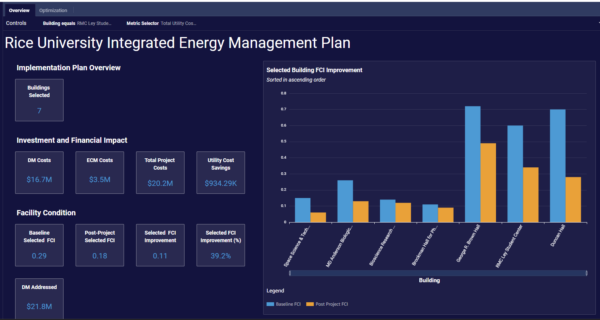
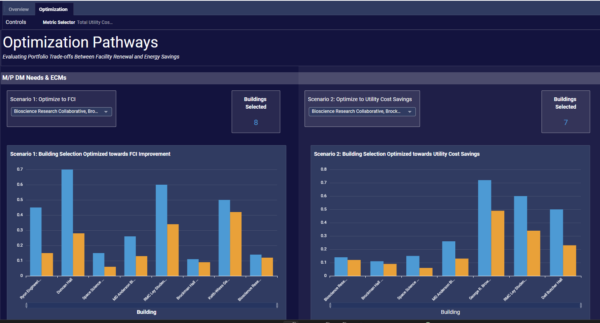
- Find the Money – We analyze your portfolio to identify “Problem Buildings” where high energy waste meets high equipment failure risk. Targeted site audits and building data analytics validate these opportunities. By understanding both deferred maintenance and energy conservation outcomes, we then build the business case, including an interactive Project Prioritization Matrix that lets you toggle scenarios to plan for the most efficient outcomes, such as maximizing energy reduction versus maximizing ROI.
- Put it to Work – Altura’s team of engineers leads an analytics-driven retro-commissioning process, what we call “Connected Commissioning” (CCx), for high-priority buildings to capitalize on low-to-no cost opportunities with strong ROIs. By strategically pairing low-to-no-cost Energy Conservation Measures (ECMs) with critical DM needs, we create a self-funding cycle where energy savings are reinvested directly back into the broader maintenance backlog.
So, Does it Work? Ask Rice University.
By applying our DM+ framework, we helped them identify high-ROI energy savings opportunities, and then created the programmatic structure needed to re-invest savings back into a broader “energy maintenance fund”. This expanded how far they could push their initial capital, increasing their overall project value by 50%.
Want to learn more? Check out our Rice University case study here.
Ready to Act?
Contact us today to learn how to transform your deferred maintenance backlog from a liability into a strategic driver for facility optimization, operational efficiency, and long-term decarbonization.
 Article Written By Jensen Widtfeldt
Jensen Widtfeldt is an Associate Principal and Director of Environmental Programs at Altura. He leads decarbonization strategies and programmatic roadmaps for national and regional enterprise, healthcare, and higher education clients.
Reach out to Jensen to learn how a Deferred Maintenance+ Program uses creative analytics to secure funding and turn millions in backlogged work into completed projects.